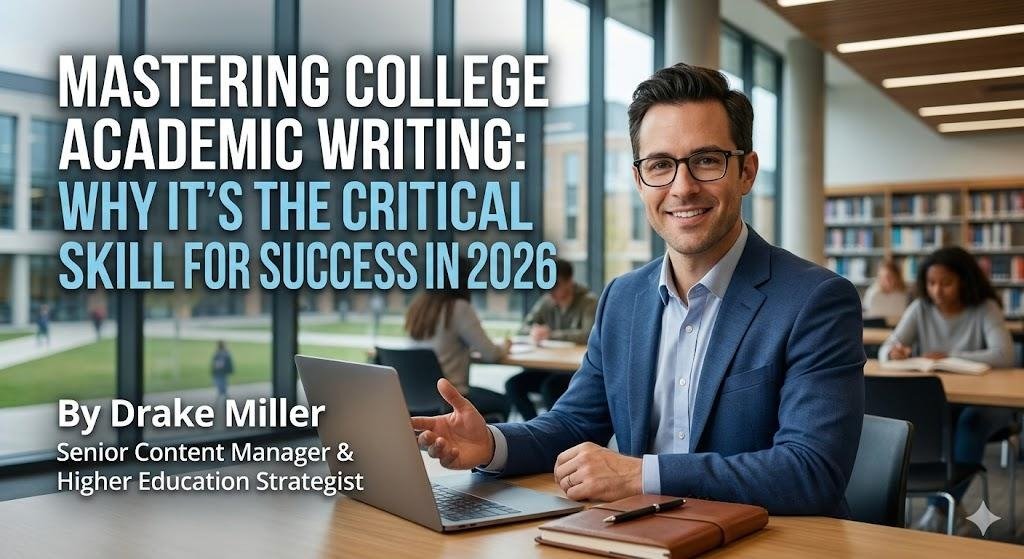
Mastering College Academic Writing: Why It’s the Critical Skill for Success in 2026
By Drake Miller Senior Content Manager & Higher Education Strategist
Transitioning from high school to higher education in the USA is often marked by a significant shift in expectations. While secondary education focuses on foundational knowledge and standardized testing, American universities demand a higher level of critical engagement, synthesis, and evidence-based persuasion. At the heart of this academic evolution lies a single, indispensable competency: college writing expectations vs. high school standards.
As a strategist with over a decade of experience observing student performance, I have seen firsthand how writing proficiency serves as the primary predictor of long-term academic and professional success. Far from being a mere hurdle to clear for a grade, academic writing is the primary vehicle through which scholars communicate, challenge established ideas, and contribute to their respective fields. When the complexity of these tasks becomes overwhelming, many students seek the guidance of a professional assignment writer to understand the nuances of university-level discourse.
Defining Academic Writing: More Than Just Grammar
Before diving into its importance, it is essential to understand what academic writing actually entails in a modern university setting. It is a formal style of expression used in scholarly publications and high-stakes degree programs. In 2026, the definition has evolved to include multimodal literacy, but the core pillars remain:
- Evidence-Based Arguments: Every claim must be supported by credible data, peer-reviewed research, or primary sources.
- Clear, Linear Structure: A logical flow that guides the reader from a provocative introduction and a strong thesis statement to cohesive body paragraphs and a forward-looking conclusion.
- The Objective Tone: Avoiding slang, colloquialisms, and personal bias in favor of a balanced, analytical perspective.
- Precise Citations and Attribution: Giving credit to original thinkers using styles like APA 7th Edition or MLA 9, which are the gold standards for US academic integrity.
1. The Catalyst for Critical Thinking and Analytical Reasoning
The most profound benefit of academic writing is that it forces the brain to synthesize information rather than just memorize it. You cannot write a cohesive, 2,000-word research paper on “The Economic Impact of Agentic AI” without first deconstructing a complex series of variables.
For students navigating technical subjects, such as mobile app development or software architecture, Android assignment help at Myassignmenthelp.com can provide the structural templates needed to bridge the gap between coding logic and academic theory. This process moves a student from being a passive consumer of information to an active producer of knowledge.
2. Mastery of Communication in a Rapid-Fire Digital Age
We live in an era of rapid-fire communication—instant messages, social media snippets, and short-form video. While these have their place in social networking, they do not cultivate the ability to sustain a complex, nuanced argument over several pages.
Academic writing teaches students how to organize their thoughts linearly. It requires a level of precision where every word counts. Learning how to explain a difficult concept, such as quantum entanglement or macroeconomic shifts in the post-pandemic era, ensures that a student can communicate effectively in any high-stakes environment, whether it’s a corporate boardroom, a medical residency, or a legal brief.
3. Building Professional Credibility and E-E-A-T
In both digital marketing and academia, the concept of E-E-A-T (Experience, Expertise, Authoritativeness, and Trustworthiness) is vital. When a student produces a high-quality, well-cited paper, they are essentially building their own “authoritative brand.”
Learning how to cite sources correctly and build a comprehensive bibliography is more than a technicality; it is an exercise in intellectual honesty. This habit of mind is essential for anyone looking to enter specialized US fields like medicine, constitutional law, or aerospace engineering.
4. Preparation for the Modern, Tech-Driven Workforce
A common question among undergraduates is: “Will I ever write an essay again once I graduate?” While you may not write another literature review on The Great Gatsby, you will almost certainly write white papers, grant proposals, strategic plans, and executive summaries.
The skills required for a college-level research paper—conducting deep-dive research, vetting digital sources, and presenting data clearly—are the exact skills needed to succeed in modern “knowledge worker” roles. In the 2026 workforce, the ability to document processes and argue for a specific ROI (Return on Investment) is rooted in the training one receives during university essay writing.
5. Bridging the Gap: From High School to University Standards
For high school seniors in the USA, the jump to college-level discourse can be jarring. High school writing often focuses on the “Five-Paragraph Essay” format and summarizes what happened. College writing, conversely, focuses on the why and the how.
By engaging with advanced academic writing early—perhaps through AP (Advanced Placement) or IB (International Baccalaureate) programs—students learn to move beyond summary and toward deep analysis. This shift is crucial for success in the American higher education system, where originality of thought and critical inquiry are highly prized over rote memorization.
6. Overcoming Common Academic Writing Challenges
Despite its importance, the transition is often met with significant hurdles. Modern students face unique “pain points” that can hinder their GPA:
- The “Blank Page” Syndrome: Often caused by a lack of structured research. The solution lies in the “pre-writing” phase—outlining and categorizing data before a single sentence is written.
- Nuanced Plagiarism: In an age of AI, the line between “inspiration” and “plagiarism” can feel thin. Understanding the difference between paraphrasing and quoting is the key to maintaining academic integrity.
- Time Management in Hybrid Environments: Long-form essays cannot be written the night before. Breaking the task into “milestones” (Research, Draft, Edit) is the best strategy for success.
For students who feel overwhelmed by the transition or the workload of a hybrid learning environment, seeking expert academic mentorship and structural support can be a game-changer, ensuring your work meets the rigorous standards of top-tier US universities.
7. The Role of Technology: Academic Writing in the Age of Agentic AI
In 2026, we cannot discuss writing without acknowledging the role of Artificial Intelligence. Tools like Agentic AI and Large Language Models (LLMs) are fundamentally changing how students conduct preliminary research and organize their data.
However, a critical distinction must be made regarding academic integrity and Agentic AI: AI is a co-pilot, not the captain. While AI can help brainstorm topics or summarize long-form articles, it cannot replace the “human element” of academic writing—the unique voice, the ethical judgment, and the lived experience of the student.
8. Global Competitiveness and the American Degree
The American higher education system is globally recognized for its emphasis on liberal arts and communication skills. Mastering academic writing ensures that a student remains competitive not just locally, but in a global job market where clear English communication is the standard for international business and scientific research.
Frequently Asked Questions
Q.1 What is the biggest difference between high school and college writing in the USA?
College writing is analytical and argumentative, focusing on “why” or “how” something happened, whereas high school focuses on “what” happened.
Q.2 How can I improve my academic writing skills before starting university?
Familiarize yourself with US-standard citation styles like APA 7 vs. MLA 9 and practice deconstructing complex academic journals.
Q.3 Is using AI considered cheating in academic writing in 2026?
AI should be used as a supplementary research tool. Submitting AI-generated text as your own is a violation of academic integrity in most US institutions.
Conclusion: A Lifelong Asset for the 21st Century
Academic writing is often viewed as a temporary requirement to secure a diploma, but it is actually a lifelong asset. It hones your brain to be sharper, your communication to be clearer, and your professional persona to be more authoritative.
About the Author
Drake Miller is a senior content manager and higher education strategist with over 12 years of experience in academic consulting and digital pedagogy. He specializes in helping students navigate the complexities of research methodologies and the integration of AI in educational environments.